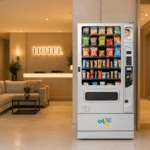

2026 is the year vending stops being “that snack box near the lift” and becomes a serious micro-retail infrastructure layer.
Not sexy.
Very compounding.
Extremely cash-flow coded.
Let’s talk prospects in vending machine manufacturing and vending machine operations—with real macro + market data
1) The 2026 setup: Macro tailwinds, messy supply chains
India: demand optimism is not a vibe; it’s measurable.
- Industrial activity: India’s IIP growth hit 6.7% (Nov 2025), driven by mining + manufacturing. (The Times of India)
- GDP growth outlook: IMF projects India around 6.6% (FY 2025–26) and global growth ~3.1% in 2026. Translation: India is playing offense while the world plays “careful.” (IMF)
- Payments rails: UPI hit a record 21.6B transactions in Dec 2025, worth about ₹28 lakh crore—your vending machine is basically a QR-enabled ATM for impulse demand. (The Economic Times)
Now the manufacturing side (where reality bites):
- Steel: India imposed a 3-year safeguard duty (11–12%) on select steel products to curb cheap imports. This can stabilize domestic pricing for some categories, but it also reshuffles procurement math for fabricators. (Reuters)
- Electronics: memory-chip tightness is back; reports warn consumer electronics prices could rise (and shortages persist) as AI demand hogs capacity. That matters for controllers, displays, payment modules, and embedded compute. (Financial Times)
2026 thesis: vending is demand-positive… but BOM discipline wins.
2) Market size: vending isn’t “small.” It’s “fragmented and underestimated.”
Different research firms size the market differently (scope varies: retail vending vs machines only vs smart vending). But direction is consistent: up and to the right.
- One 2025 report pegs the global vending machines market at ~$23.07B (2024) → $25.88B (2025) → $34.96B (2030) (~6.2% CAGR). (nextmsc.com)
- Another “retail vending machine market” framing is larger: $72.10B (2024) → $89.27B (2030) (~3.7% CAGR). (Grand View Research)
- Smart / connected segments are growing faster:
- “Connected vending” shipments: 8.08M units (2025) → 14.30M (2030) (~12.1% CAGR). (Mordor Intelligence)
- “Smart vending machines” projections show double-digit CAGR into the 2030s. (Zion Market Research)
What this means for 2026: the “dumb box” is becoming a networked retail endpoint—hardware + software + payments + logistics.
3) 2026 prospects in manufacturing: where the margins will move
A) The BOM is the battlefield
Steel + refrigeration + electronics = your cost structure.
- Steel demand in India is expected to grow ~9% in 2025 and 2026 (worldsteel short-range outlook). Rising demand can keep pressure on certain product categories and supply allocation. (worldsteel.org)
- Electronics volatility is non-linear: one part shortage can stall full shipments. Memory tightness is an early warning; vendors with alternative modules and second-source designs win. (Financial Times)
Manufacturing play for 2026:
Design for substitution.
Standardize panels + harnesses.
Keep controller modular.
Treat “availability” as a feature.
B) Refrigerated vending is not optional anymore
Cold chain is where higher ticket sizes live: dairy, protein, fresh-ish, premium beverages.
- Refrigerated vending market estimates put it at ~$6.9B (2025) heading toward ~$13.3B (2034). (Global Market Insights Inc.)
C) Compliance + sustainability becomes procurement criteria
Corporate buyers (offices, campuses, hospitals) increasingly ask:
- energy efficiency,
- audit logs,
- remote uptime,
- refill traceability,
- “healthier options” reporting.
Smart telemetry isn’t “nice”—it’s how you win tenders.
4) 2026 prospects in the vending business: operators finally get unfair advantages
A) Payments are solved (especially in India)
UPI at scale means:
- zero cash handling drama,
- lower shrinkage,
- faster throughput,
- better attribution (what sells, where, when). (The Economic Times)
And India’s digital payments ecosystem is projected to keep expanding sharply into 2030 (transaction growth projections). (PwC)
Operator edge: the real asset is not the machine.
It’s the dataset of demand + the locations contract.
B) The unit economics are quietly improving with telemetry
Connected vending is growing because it lifts:
- uptime (predictive maintenance),
- stock accuracy,
- refill efficiency,
- route profitability. (Mordor Intelligence)
Less “daily visit” operations.
More “only visit when margin says so.”
C) New placement logic: vending becomes “micro retail infra”
2026 placement winners:
- corporate parks + shared workspaces,
- hospitals + diagnostics chains,
- transit-adjacent footfall,
- educational campuses,
- gated communities (premium SKUs),
- factory clusters (high-frequency basics).
Your pitch is not “snacks.”
Your pitch is 24/7 retail without staffing.
5) The 2026 playbook (Twitter brain edition)
If you manufacture:
- Build two lines: standard + smart-ready (same chassis, different brains).
- Make payments a plug-in: QR-first, with optional card/NFC.
- Design serviceability like a weapon: doors, locks, compressor access, swap-friendly modules.
- Offer AMC like SaaS: uptime SLAs, remote diagnostics, part swaps.
If you operate:
- Stop chasing “more machines.” Chase better locations.
- Run A/B tests on SKUs like you’re an e-commerce brand.
- Use telemetry to cut route cost; route cost is the silent killer.
- Sell B2B convenience: “We manage it end-to-end; you just provide space + power + footfall.”
6) Risks (because 2026 is not a fairy tale)
- Component shocks: chip and memory constraints can push lead times and costs. (Financial Times)
- Input price policy churn: steel trade measures change the procurement map. (Reuters)
- Operations risk: theft, vandalism, and poor service discipline can wipe out “great margins” on paper.
Risk isn’t a reason to avoid vending.
It’s a reason to professionalize it.
Bottom line for 2026
Vending in 2026 is the convergence of:
- payments at scale (UPI),
- IoT and route optimization,
- premiumization (fresh + cold + higher ASP),
- corporate procurement maturity.
If 2025 was “install machines,”
2026 is “build networks.”
Happy New Year 2026.
May your machines stay online, your compressors stay cold, and your refill routes stay profitable.